Before Lagos Became Lagos, There Was Efunroye. On May 1, She Finally Gets Her Film.
Faithia Williams spent years carrying a story the industry was not ready to make. She buried her mother, kept working, and is opening Efunroye: The Unicorn in cinemas nationwide on May 1. The woman she is bringing to screen built the Lagos we live in. That is not an exaggeration.
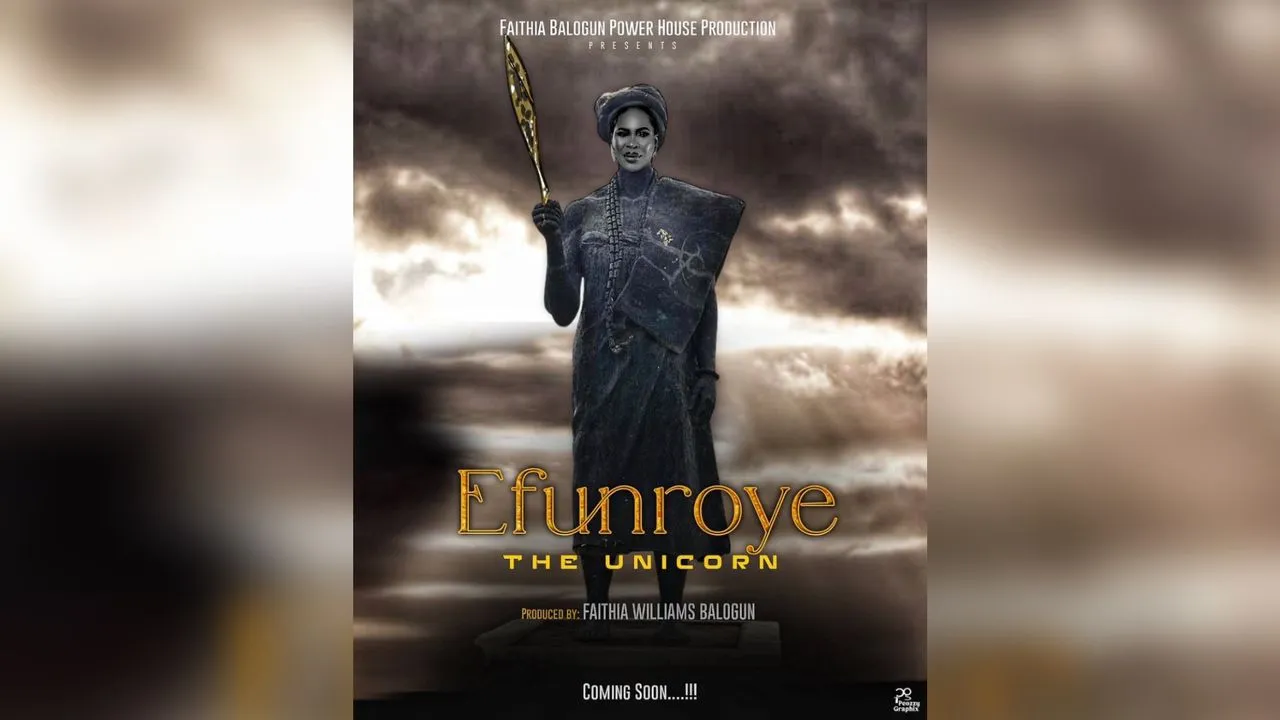
There is a scene in the Efunroye trailer that lasts about four seconds. Faithia Williams, in full 19th-century Yoruba regalia, turns to face whatever is coming. She does not flinch. The look on her face is not defiance exactly. It is older than defiance. It is the look of a woman who has already counted the cost and paid it in advance and is simply waiting for the world to catch up with a decision she has already made.
You could read that as Faithia Williams the actress performing a character. You would not be wrong. You would also be missing the layer that anyone who has followed the production of this film will see immediately.
Faithia Williams has been trying to make this film for years. She has been building toward it, talking about it, carrying the research, assembling the cast, finding the money, losing the money, finding it again. The project has outlasted false starts and funding gaps and the specific kind of exhaustion that comes from trying to get a large, expensive, culturally serious film made in an industry that is more comfortable with what it already knows. And then, in the middle of the final production push, her mother died.
She kept working. The film opens May 1.
This is one version of what Efunroye: The Unicorn is. The other version is that it is a historical epic about the most powerful woman in 19th-century Lagos, a figure who shaped who sat on the throne of Lagos, who controlled significant trade routes at a moment when British colonial forces were rearranging everything, who was feared and respected in equal measure by the men who surrounded her, and whose name you cannot understand modern Lagos without understanding.
Both versions are the same film. That is why it matters.
The woman herself
Efunroye Tinubu was born near Abeokuta into a family of market traders. She learned the tradecraft from her mother and her grandmother — the specific intelligence of commerce, of reading what people need before they know they need it, of building relationships that compound over time into something resembling authority. She married the exiled Prince Adele, moved to Lagos, and began building a commercial empire at a moment when Lagos was becoming the fulcrum of West African trade.
What she built was not simply a business. It was an infrastructure of influence. She controlled trade. She controlled who had access to the Europeans and on what terms. She understood that the people who controlled access controlled everything, and she made herself indispensable to transactions on multiple sides simultaneously. By the time British colonial ambition was pressing down on Lagos in the 1850s and 1860s, Efunroye Tinubu was a political force that even Governor Benjamin Campbell could not simply dismiss.
She was eventually exiled to Abeokuta in 1856 following disputes with the colonial administration — but exile did not diminish her. In Abeokuta she rose again, became a major figure in the resistance against the Dahomean attacks on the city, was granted the title of Iyalode, and continued operating until her death. The British called her troublesome. The Yoruba called her Unicorn. The people of Abeokuta erected a statue to her. Her name runs through Lagos history as a current runs through a river — always present, not always visible from the surface.
This is the figure that Faithia Williams has spent years fighting to bring to screen.
What the film has assembled
The cast is the clearest signal of how seriously this production has been taken by everyone who agreed to be in it. Odunlade Adekola. Mercy Aigbe. Ibrahim Chatta. Femi Adebayo. Saidi Balogun. Taiwo Hassan. Layi Wasabi. Eniola Ajao. Femi Branch. Ibrahim Yekini. Muyiwa Ademola. Kolawole Ajeyemi. Foluke Daramola. Produced by Faithia Williams alongside Niyi Akinmolayan — the director of Anthill Studios and one of the most commercially disciplined creative executives in Nigerian film — alongside Diran Adeyinka and Kemi Anibaba.
The presence of Niyi Akinmolayan is not incidental. He does not attach his name to productions casually, and his involvement in the producing structure of a historical epic about Efunroye Tinubu suggests that the commercial architecture of the film has been thought through with the same seriousness as the cultural argument.
READ ALSO: The Film That Changed Nigeria’s Box Office
The film is directed by Adebayo Tijani and Tope Adebayo Salami — the team behind Anikulapo’s visual universe among other productions, filmmakers whose facility with the specific visual grammar of Yoruba historical epic has been demonstrated across multiple projects. The language of the film is Yoruba. This is not a concession to its subject matter. It is a creative conviction.
FilmOne is distributing.
The personal weight
When Faithia Williams announced the May 1 release date, she said something that the promotional machinery of a film launch usually does not make room for. She said her mother had died. She said she had not even buried her yet. She said: “I could have stayed away. I could have mourned in silence. But I thought about how many times I almost gave up on this project. How many times I told myself it was too big, too expensive, too much. And I thought: Mama, this one is for you.”
There is a tradition in Nigerian film of the star producer who channels something personal into a production and arrives with that energy visible in every frame. Funke Akindele has it. Toyin Abraham has it. It is not sentiment. It is fuel — the specific combustion of personal stakes and professional investment that makes a film push harder than it otherwise would have, that makes the marketing more urgent and the performance more inhabited and the audience more willing to feel something.
Faithia Williams arrives at Efunroye: The Unicorn with grief and with decades of commitment to this story and with the specific understanding that the woman she is playing came back from exile and kept building. There is a reason she chose this subject. The film knows it. Watch her face in that trailer again. She is not performing conviction. She is operating from it.
What Yoruba cinema is building
The arrival of Efunroye on May 1 is also an industry story, not just a cultural one.
The Yoruba-language sector of Nigerian cinema has been commercially consistent in ways that the English-language mainstream has not always acknowledged proportionately. Ori: The Rebirth grossed ₦419 million in 2025. Labake Olododo grossed ₦264 million. Iyalode grossed ₦306 million. Abanisete grossed ₦164 million. These are not marginal numbers. They are the commercial backbone of Nollywood’s middle tier in a year that produced ₦15.6 billion in total box office, and they are built on an audience relationship — with Yoruba language, with Yoruba history, with Yoruba performance styles — that has its own specific commercial logic distinct from the Lagos English-language blockbuster model.
Efunroye: The Unicorn arrives at this moment as the most ambitious single production the Yoruba-language epic format has attempted this year. A real historical figure. A full-scale period production. An ensemble that includes the genre’s most commercially reliable names. A story with stakes that are not mythological but biographical — a woman who actually existed, whose choices actually shaped the city you live in, whose exile and return are not fictional metaphor but documented fact.
That combination — historical truth, commercial scale, personal urgency from the filmmaker — is rare in any cinema. It is particularly rare in Nigerian cinema, where the pressures toward the familiar and the fast are constant.
May 1 is eleven days away. Pay attention.
Efunroye: The Unicorn opens in cinemas nationwide May 1, 2026. Dir. Adebayo Tijani & Tope Adebayo Salami · Prod. Faithia Williams, Niyi Akinmolayan, Diran Adeyinka, Kemi Anibaba · Dist. FilmOne Entertainment · Yoruba-language historical epic.

Kate Adeyemi is NollyPrime's Senior Industry Correspondent. She has covered the business of Nigerian film and television for fourteen years.